
Turning Out for Constitution Day

By Kathleen Guthrie Woods
Kathleen Guthrie Woods is a long-time contributor to San Francisco Attorney magazine. Previous articles include “For the Kids: Arguments in Favor of Right to Counsel” (Summer 2019) and “Miranda at Fifty” (Fall 2016).
On September 17, two hundred and thirty-eight years after thirty-nine Founding Fathers signed the U.S. Constitution, lawyers, judges, and concerned citizens around the country gathered to celebrate and reaffirm their commitment to this sacred document, which they believe is imperiled. The San Francisco Trial Lawyers Association (SFTLA) observed Constitution Day by hosting “Voices of the Constitution: A Rally for Rights and Rule of Law.”
In the plaza at the Phillip Burton Federal Building, attendees took time out of their busy schedules to learn from and be inspired by prominent speakers, including the Honorable Tani Cantil-Sakauye, Dean Erwin Chemerinsky, and Honey Mahogany.
Our Duty to Speak Out
SFTLA President Bobby Shukla opened by acknowledging the coalition of legal organizations that sponsored the day’s program (American Constitution Society (ACS), ADR Services Inc., BALIF, BASF, and Consumer Attorneys of California) and dubbing the event “a rallying cry.” While a fair and just society relies on the rule of law, she said, our Constitution and the Bill of Rights are under attack. “As citizens, it is our duty to speak out.”
Since the birth of our nation, citizens and elected representatives have spoken out to interpret, debate, refute, and/or defend these documents and apply their tenets to contemporary issues. On one side, proponents of originalism argue the U.S. Constitution should be taken at face value, based on an understanding of the framers’ “original intent.” Others believe our needs are evolving and argue these documents must be examined and interpreted for their application to developments the framers couldn’t have possibly anticipated (such as the Industrial Revolution, the Digital Age, social media, and artificial intelligence).
Both sides have fought for their beliefs, resulting in the proposals of nearly twelve thousand amendments since 1789 (the Bill of Rights was ratified on December 15, 1791), of which only 27 have passed. (Number 27, regarding compensation for members of Congress, was ratified in May of 1992.)
What most agree upon is that the U.S. Constitution and its current amendments are the foundation of our democracy, and they are in need of our attention and protection. When asked which amendments she thought were most at risk, an attendee named Dale said, “The 13th Amendment, 14th Amendment, 15th Amendment. And due process, the 1st Amendment, and certainly the 4th, the 5th, the 6th.” She laughed when it was suggested she’d included them all, and responded soberly, “I think the whole Constitution is at risk, which is why I’m here.”
Several attendees expressed concerns about recent acts of apparent political retribution, including the indictment of former FBI Director James Comey. (Additionally, New York Attorney General Leticia James was indicted on October 9.) “We have to do what we can,” Lisa, an attorney, said, in answer to why she was at the Constitution Day gathering. “I mean, it’s about presence, it’s about making an appearance, it’s about letting people know that we’re fighting back, that we’re not just going to lay down and take this.”
“We will fight for this and more,” Shukla said in her closing remarks. She then introduced the speakers who would read passages from the Constitution and offer their thoughts.
We the People…
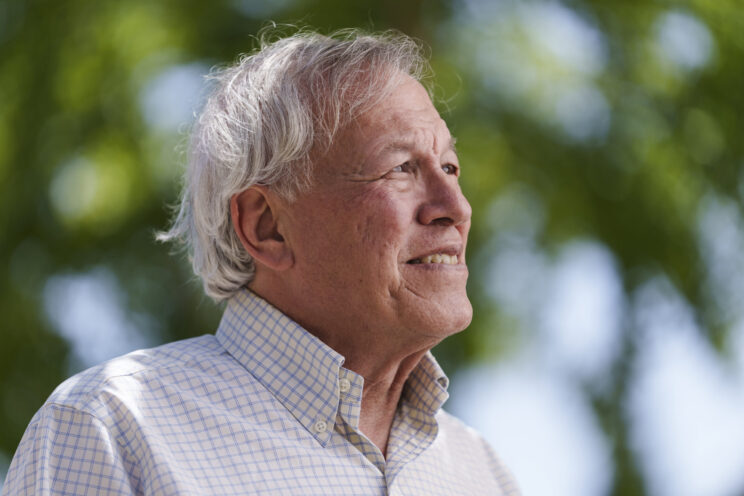
“I am out here today in part because I am a fan and a devotee of the United States Constitution,” the Honorable Tani Cantil-Sakauye said in a brief interview shortly before stepping up to the podium, “and I think this is a moment of inflection.” The former Chief Justice of California, and the first woman of color to serve in that role, Justice Cantil-Sakauye is currently president and CEO of the Public Policy Institute of California.
Reading from the Constitution’s preamble, she placed emphasis on the active verbs: “establish Justice, ensure domestic Tranquility, provide for the common defense….” But her focus was on the opening words and who they did, and did not, represent.
“We the People” granted rights to white men who owned property, like the ones who drafted and signed the first document. At the time, that represented about one-third of the country’s population and excluded enslaved African Americans, servants, Native Americans, and women. “Only through lawyers’ arguments and justices’ rulings,” which sometimes resulted in amendments, Justice Cantil-Sakauye said, are the broader range of Americans protected. The original document, she said, was “not universally loved and adopted,” and “bargaining had to happen” over time for everyone to be protected under the rule of law.
Take voting rights for example. It wasn’t until 1856 that poor white men were able to vote, having been barred in many states by religious and property ownership requirements. Men of color were denied the right to vote until the 15th Amendment was ratified in 1870. (However, poll taxes and tests of literacy, practices employed primarily in southern states, frequently made the act of casting a ballot impossible. The Voting Rights Act didn’t address this until 1965.) Women finally won the right to vote with the ratification of the 19th Amendment in 1920.
Threats to the First Amendment
Our constitution, our democracy, is facing “more serious threat(s) than at any time in its history,” Dean Erwin Chemerinsky shared with the crowd. “I am more afraid than I have ever been for our democracy.” In a follow-up interview, Chemerinsky, a constitution expert and Dean and Professor of Law at UC Berkeley School of Law, elaborated. “Since January 20, there is a president who violated constitutional laws, expanded presidential powers, and used the powers of government for retribution.” Without checks from the legislative and judicial branches of our government, and if the Supreme Court “rubber stamps” the president’s actions, “will there be anything left of our constitutional democracy?” he asked in a recent op-ed.
“Look at what happened in Hungary and Turkey,” he said. “It’s so much the path we’re on now.” He referred to Hungarian Prime Minister Viktor Orbán’s attacks on universities, which began in 2010 with threats of funding cuts that sound similar to the threats top U.S. universities face if they don’t comply with the current administration’s demands. Harvard, Princeton, and the University of California have all been targeted. In Turkey, the government led by President Recep Tayyip Erdogan took control of newspapers, TV stations, radio programs, and periodicals, and issued arrest warrants for journalists who dared to dissent. In July 2025, a Deutsche Welle article cited reports from Reporters Without Borders and the International Press Institute (IPI) that “more than 95% of Turkish media…are either directly or indirectly run by businesspeople loyal to the government.” Those governments not only ignored the laws and constitutions of their countries, Dean Chemerinsky said, they also used the power of government to punish their adversaries.
At the Constitution Day event, Dean Chemerinsky read the 1st Amendment. “This is the one that is first,” he said, and that’s because “it’s the impulse of any government to stop [the words] it doesn’t like” and penalize organizations, including law firms, for views they express. There can’t be a democracy without free press, free speech, and the right to assemble, Dean Chemerinsky said, and “these rights will only survive if we fight for them.”
Many are willing to fight for these rights. In mid-October, journalists at the Pentagon chose to turn in their press passes rather than adhere to new restrictive rules for the media’s coverage of the U.S. military.
Equal Protections for All
Honey Mahogany, Director of San Francisco’s Office of Transgender Initiatives, was the final speaker of the day. A social worker, an LGBTQ advocate, and the first transgender person in the country to serve as Chair of the Democratic County Central Committee (DCCC), Mahogany shared that she was also speaking as the child of immigrants when she read from the 14th Amendment.
It begins with “All persons…,” then promises “to provide ‘equal protection of the laws’ and ‘due process of law’ to all people.” However, what we’re seeing in this country now, Mahagony said, is “not just the rollback of our rights, but a clear disregard for the laws.” She shared some of her family’s story, about her father who had his Ethiopian citizenship and visa revoked while he was studying in Greece, because he was organizing protests. He made his way to San Francisco in search of the American dream. What’s happening in the U.S. “would break his heart if he were alive today,” she said.
Attendees also voiced related concerns about sustainability of the 4th Amendment, which offers protection against unreasonable searches and seizures, tactics frequently associated with racial profiling. Barbara, an attorney, was motivated to attend the Constitution Day rally by the Supreme Court’s decision, announced the night before, in Noem v. Vasquez Perdomo. “I’m especially nervous after I heard the Supreme Court said it’s okay to detain people. I just can’t believe it, can you? Every day gets worse and worse,” she said. “The Fourth Amendment protects every individual’s constitutional right to be ‘free from arbitrary interference by law officers.’ Brignoni-Ponce, 422 U. S., at 878,” Justice Sotomayor wrote in her dissent. “After today, that may no longer be true for those who happen to look a certain way, speak a certain way, and appear to work a certain type of legitimate job that pays very little…this is unconscionably irreconcilable with our Nation’s constitutional guarantees.”
Mahogany gave a shout out to people who are immigrants and transgender, two communities of people who are directly under fire. Lauding people who dare to come to this country, who contribute their labors and ideas, she encouraged embracing diversity of all kinds, of thought and of gender. “Trans people,” she said to the crowd, “embody the pursuit of life, liberty, and happiness.”
Finding Hope
“I go to a lot of protests myself, and I find that it reinvigorates my fighting spirit,” Barbara said. “Fight fight fight. It’s kind of like litigation: You just keep fighting.” Lisa also finds hope “in organization, in resistance, in the energy of gatherings” like the Constitution Day rally. “It makes me feel better that I’m surrounded by people who are like-minded and want to preserve our Constitution,” Dale said.
In the meantime, there are actions attorneys can take. Get involved. Donate to candidates and causes. Speak out, sign petitions, write op-eds, and attend rallies. “We’re the guardians of the Rule of Law,” Dean Chemerinky said, and “it’s our responsibility to help inform other people.”